
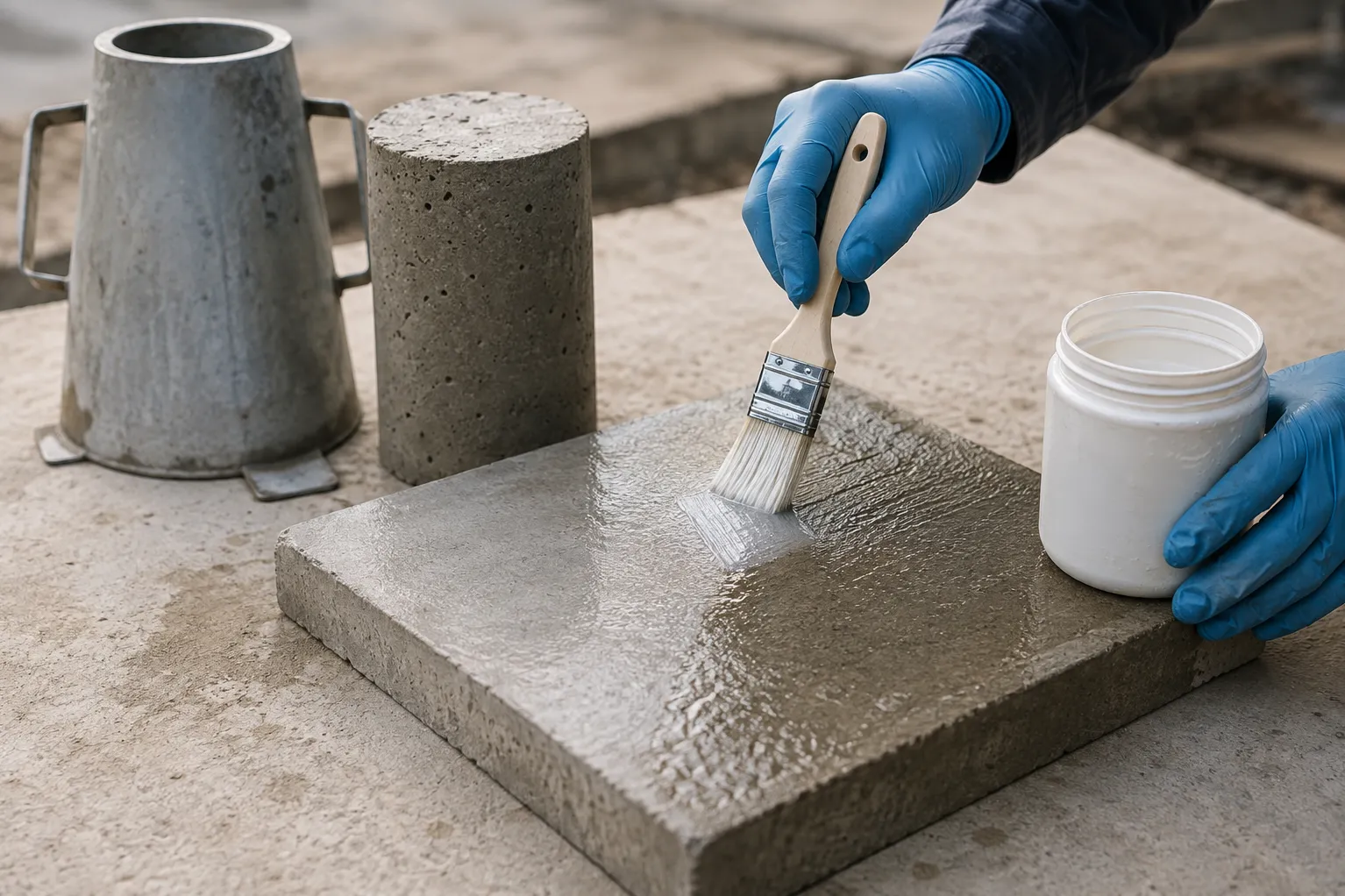
Fresh concrete needs sufficient moisture for cement hydration and strength development. When water evaporates too quickly, the concrete surface may become vulnerable to plastic shrinkage cracking, dusting and reduced durability. Curing compounds are applied to create a membrane that limits moisture loss, especially where continuous water curing is difficult.
Becquerel Industries Pvt Ltd provides laboratory testing support for curing compounds used in concrete construction. Testing helps contractors, manufacturers and project consultants evaluate whether a product possesses the required application and moisture-retention characteristics.
What Is a Concrete Curing Compound?
A curing compound is a liquid product applied to exposed concrete surfaces after finishing. It forms a membrane that reduces evaporation and supports moisture retention during the early curing period.
Curing compounds are frequently used for:
- Concrete roads and pavements
- Bridge decks
- Industrial floors
- Airport pavements
- Large slabs
- Precast elements
- Canal linings
- Hard-to-access concrete surfaces
The compound may be applied by spraying, roller or another approved method. Uniform coverage is important because missed areas can lose moisture faster than the surrounding surface.
Why Curing Compound Testing Is Important
A product may appear to form a surface film but still provide inadequate moisture retention. Laboratory testing helps evaluate relevant properties under controlled conditions.
Quality checks can support:
- Product approval before site use
- Comparison between suppliers
- Verification of delivered batches
- Manufacturer quality control
- Investigation of curing-related surface defects
- Compliance with project specifications
- Evaluation of application characteristics
The applicable tests depend on the product type and the standard or specification adopted by the project.
Key Properties Evaluated in the Laboratory
Water-Retention Efficiency
The primary purpose of a curing compound is to limit moisture loss. Testing may compare water loss from a treated specimen with defined acceptance requirements under controlled exposure conditions.
This property is important because the visible formation of a film does not by itself establish effective curing performance.
Drying Time
The compound should dry within a suitable period after application. A surface that remains tacky for too long may collect dust, interfere with site activity or become damaged before the membrane develops properly.
Drying performance can vary with temperature, humidity and application thickness.
Density and Consistency
Density measurements can help identify differences between batches. Consistency and application behaviour influence whether the product can be sprayed or spread evenly over the concrete surface.
Reflectance or Pigmentation
Some curing compounds contain light-coloured pigments to improve visibility during application or reduce heat absorption from sunlight. Where specified, reflectance and pigment-related properties may form part of the evaluation.
Film Formation
The formed membrane may be assessed for uniformity and visible defects. Cracking, pinholes or incomplete film development can reduce moisture-retention performance.
Curing Compound Use in Nagpur’s Climate
High daytime temperatures, dry winds and direct sunlight can accelerate moisture loss from newly placed concrete in Nagpur and across the Vidarbha region. Large exposed areas such as road slabs and industrial floors can be particularly difficult to cure uniformly.
Good site practice includes:
- Confirming that the product is suitable for the application
- Mixing or agitating it as recommended
- Applying it at the specified coverage rate
- Using calibrated spraying equipment
- Achieving complete and uniform coverage
- Protecting the membrane from early damage
- Checking compatibility with later finishes or coatings
A tested product can still underperform if it is applied too thinly, unevenly or at the wrong stage.
Selecting and Submitting a Sample for Testing
The submitted sample should represent the supplied batch and remain in its original sealed condition where possible. Batch details, manufacturing date, product category and specified test requirements should accompany it.
Before using a curing compound for concrete work in Nagpur, contact Becquerel Industries Pvt Ltd to discuss the product, project specification and required laboratory parameters. Timely testing can support material approval and help project teams establish a more dependable curing plan.
Keywords