A cement plant places heavy, tall, vibration-sensitive and settlement-sensitive structures across one large site, so a few bearing-capacity boreholes cannot support the design. By the end, you will know how to divide the site into investigation zones, select field and laboratory tests, evaluate groundwater and ground hazards, and judge whether the final report supports foundations, roads, utilities and construction work.
Key takeaways
- Map every structure, service corridor, road and temporary platform before drilling.
- Set investigation depth below each foundation’s stress-influence zone, not at a fixed site depth.
- Test expansive soil, collapsible fill, weak rock, groundwater and liquefaction risk separately.
- Demand foundation parameters, settlement estimates, seismic inputs and construction controls in the report.
Why a Cement Plant Needs a Plant-Wide Ground Model
A few boreholes that establish allowable bearing pressure cannot represent a cement plant. A plant-wide ground model must cover the kiln and preheater towers, raw-mill and cement-mill buildings, crushers, clinker storage, silos, packers, warehouses, conveyor trestles, chimneys, tanks, roads, rail sidings, drainage, underground services and temporary construction platforms.
Each area transfers load and risk to the ground differently:
| Zone | Geotechnical information needed | Why it matters |
|---|---|---|
| Kiln, mill and crusher foundations | Settlement, stiffness, vibration response, weak layers and rock profile | Differential movement or poor dynamic performance can misalign machinery |
| Silos, clinker stores and stockpiles | Compressibility, shear strength, consolidation and groundwater | Large concentrated loads can cause total or differential settlement |
| Towers, chimneys and tanks | Bearing, lateral resistance, wind overturning, groundwater and uplift | Tall or buoyant structures impose stability and excavation demands |
| Roads, rail sidings and hardstands | Subgrade strength, fill quality, drainage and seasonal moisture | Weak platforms rut, pump or settle under repeated traffic |
| Services, drainage and retaining works | Excavation stability, buried obstructions, permeability and chemical exposure | Water ingress, collapse, corrosion or inaccessible utilities can disrupt construction |
A cement plant soil investigation must separate natural soil from uncontrolled fill, buried debris, old foundations, abandoned utilities, desiccated zones and imported platform material. A site investigation for industrial construction also needs design groundwater levels, not just a single borehole water reading; piezometers or repeat readings can expose seasonal recharge and uplift risk.
Report total and differential settlement assumptions, including loads, foundation dimensions, fill, drainage and equipment movement limits.
How to Plan Boreholes, Tests and Investigation Depth
Do not lay out a uniform borehole grid and assume it represents a cement plant. Tie each location to the process layout, foundation load and ground risk.
A geotechnical investigation for cement plant construction in Nagpur should begin with records, geological mapping and a walkover to locate uncontrolled fill, buried debris, old foundations, abandoned utilities and cut-to-fill boundaries.
- Place closely spaced boreholes at kiln piers, preheater towers, crushers, mills, silos, chimneys, heavy equipment and vibration-sensitive foundations. Add trial pits to inspect shallow fill, hardstand construction and utility corridors.
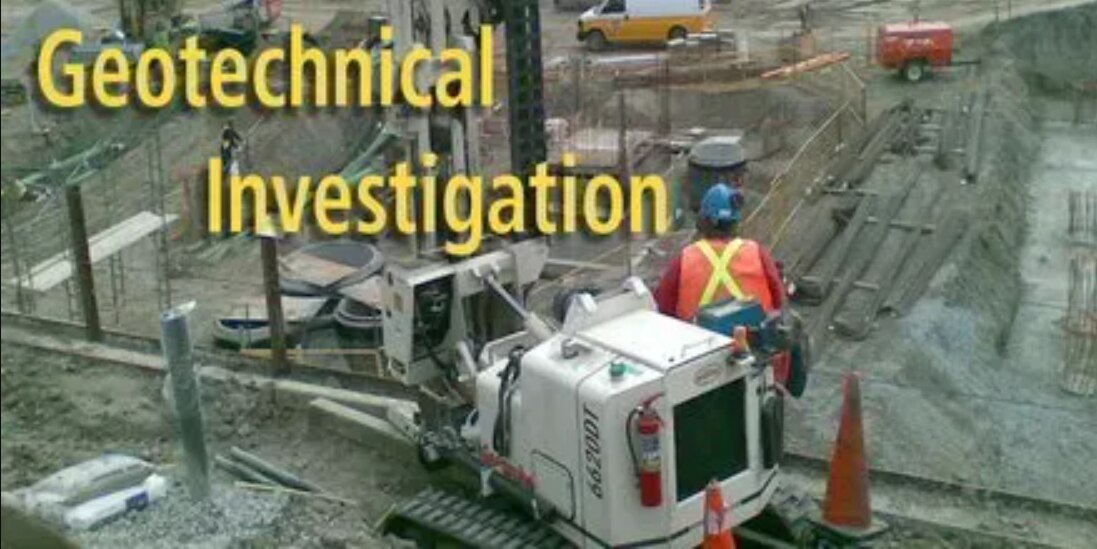
- Use Standard Penetration Tests and undisturbed samples in soil; use Cone Penetration Tests where continuous profiling and liquefaction screening are useful. Use rock coring when refusal, weathered rock, cavities or pile founding is possible.
- Extend the investigation below the stress influence zone, or below the proposed pile toe and excavation base. Stop only after competent rock or a demonstrably adequate thickness of suitable soil is proven.
- Install piezometers or repeat water-level readings where basements, deep excavations, dewatering, uplift or seasonal recharge could affect design. A drilling-time water reading is not a design groundwater level.
| Zone | Field approach | Termination trigger |
|---|---|---|
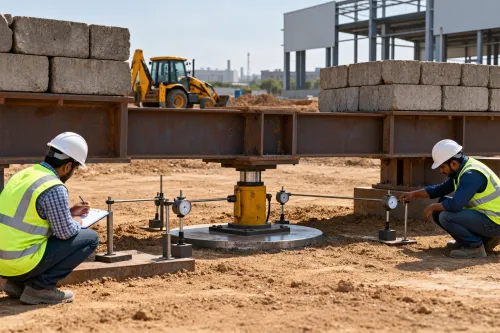
| Kiln, mills and heavy equipment | Boreholes, SPT, samples, plate-load tests and dynamic assessment | Below the stress zone and any weak or compressible layer |
| Silos, towers and chimneys | Closely spaced boreholes, CPT and rock cores | Competent founding stratum beneath pile or raft influence |
| Roads, yards and utilities | Trial pits, shallow borings and geophysics | Below formation level and unsuitable fill |
| Piles or deep excavation | Deep boreholes, coring and groundwater monitoring | Verified pile toe or excavation support stratum |
This site investigation for industrial construction must report variability rather than average it away. Separate measured logs from interpreted parameters and recommendations.
Which Soil, Rock and Groundwater Hazards Must Be Tested
An allowable bearing pressure will not reveal every failure risk. A cement plant soil investigation must test residual, alluvial, weathered-rock and filled ground for total and differential settlement, shrink–swell heave, weak seams, collapsible layers and excavation instability.
Field logs should record black-cotton soil, loose sand, uncontrolled fill, seepage, cavities, rock quality, weathering and fractures. Sample moisture content, density, grain size, Atterberg limits, swell potential or swell pressure, consolidation, shear strength and permeability. Test rock core recovery, RQD, UCS and discontinuities where foundations or excavations bear on rock.
| Hazard | Evidence to test | Likely construction problem |
|---|---|---|
| Expansive black-cotton soil | Moisture, plasticity, swell pressure, seasonal water levels | Heave during wetting and shrinkage beneath slabs, silos or roads |
| Loose saturated sand | SPT or CPT resistance, grading, groundwater and seismic screening | Settlement or liquefaction-related deformation |
| Weak or variable strata | Borehole logs, test pits, consolidation and shear tests | Differential settlement beneath kilns, mills and storage structures |
| Weathered or fractured rock | Core recovery, RQD, UCS and fracture mapping | Uneven bearing, wedge failure or difficult excavation |
| Aggressive groundwater or soil | Sulfate, chloride, pH and other chemical tests | Concrete deterioration and steel corrosion |
Do not treat a borehole water reading as the design groundwater level. Use piezometers or repeat readings after drilling fluids dissipate, including seasonal monitoring for uplift, dewatering, deep excavations and drainage. State the assumptions behind settlement estimates, including fill placement, drainage, groundwater and construction sequence.
Geological sections must show variability and uncertainty, not hide them behind one average value.
How Ground Conditions Translate into Foundation and Equipment Design
An allowable soil pressure does not prove that a kiln, silo or mill foundation will perform. Check total and differential settlement against equipment movement limits, using stated foundation dimensions, load combinations, fill placement, drainage, groundwater level and construction sequence.
Use the investigation to resolve these design checks:
- Shallow foundations: bearing capacity, sliding, overturning, eccentric loading, punching and settlement through weak or filled layers.
- Rafts: contact-pressure distribution, flexural and punching demands, consolidation, edge effects and differential movement between heavily and lightly loaded zones.
- Piles: axial compression and tension, lateral loads, group interaction, negative skin friction, pile settlement, rock-socket capacity and integrity or load-test requirements.
- Silos: annular and eccentric loads, discharge-induced load changes, seismic overturning, foundation rotation and allowable differential settlement that prevents wall distortion.
- Tall structures: wind and seismic overturning, lateral stiffness, foundation rotation, uplift, liquefaction screening and settlement compatibility with connected conveyors or ducts.
- Dynamic equipment: machine frequency versus soil-foundation natural frequency, vibration amplitude, fatigue, cyclic densification and isolation from adjacent structures.
- Kiln and preheater areas: thermal gradients, heat-affected soil, cooling-water leakage, expansion joints, anchor loads and differential movement that could misalign the kiln shell.
Geotechnical services for cement manufacturers should link sulfate, chloride and pH results to concrete durability, reinforcement cover, coatings and buried-pipe protection. A geotechnical investigation for cement plant construction in Nagpur must also verify assumptions during excavation and piling, not merely issue a bearing-capacity value.
What a Decision-Ready Geotechnical Report Should Deliver
Before foundation and earthwork decisions, the report must show what was measured, what was inferred, and what remains uncertain. For geotechnical investigation in Nagpur, require borehole and trial-pit logs, groundwater readings, laboratory results, geological sections, geotechnical profiles, and mapped uncontrolled fill, debris, old foundations and utility corridors.
Include variability by plant zone, plus seismic and liquefaction screening where applicable.
| Deliverable | Decision it supports | Evidence and assumptions required |
|---|---|---|
| Foundation parameters | Footing, raft or pile selection | Bearing pressure, total and differential settlement, shear strength, compressibility, dimensions, load combinations and groundwater level |
| Plant-wide earthwork model | Fill, roads, hardstands and drainage | Existing and proposed levels, material classification, compaction targets, moisture limits, cut-and-fill balance and slope stability |
| Durability assessment | Concrete and buried-service protection | Sulfate, chloride, pH and other chemical results linked to exposure class, concrete specification, cover, coatings and pipe protection |
| Construction verification plan | Control during excavation and piling | Hold points, unsuitable-material removal, dewatering, proof-rolling, pile refusal criteria and confirmation testing |
Cite the project’s adopted editions of IS 1892, IS 1498, the IS 2720 series, IS 1904, IS 2911 and IS 1893, then reconcile them with equipment-vendor movement limits and international process-equipment standards. Geotechnical services for cement manufacturers must state construction sequence, fill placement and drainage assumptions.
A site investigation for industrial construction is incomplete without inspection and testing procedures that confirm those assumptions as work exposes the ground. Becquerel Industries Pvt Ltd can be assessed against this deliverable-based scope rather than a borehole count.
Related products
 | Geotechnical Investigation Service in Nagpur. View product → |
 | Soil Investigation Service in Nagpur. View product → |
Frequently asked questions
Why does a cement plant need a plant-wide ground model?
A cement plant combines heavy, vibration-sensitive and settlement-sensitive structures, including kilns, mills, silos, crushers, towers, chimneys, conveyors, roads and buried services. A few boreholes cannot represent all their different foundation conditions.
How should boreholes and investigation depth be planned for a cement plant?
Place boreholes and test points across major structures, loading zones, conveyor corridors, storage areas, roads and drainage. Extend exploration through weak or compressible layers and below the foundation stress-influence zone, then increase depth where rock quality, groundwater or deep settlement controls design.
Which ground hazards must a cement plant soil investigation test?
Test for variable fill, loose or collapsible soil, expansive clay, compressible layers, weak or weathered rock, cavities, groundwater, aggressive chemicals and liquefaction where seismic conditions warrant it. Use field tests, sampling, laboratory testing and groundwater observations to confirm each hazard.
What should a decision-ready geotechnical report deliver?
The report should provide a ground model, borehole logs, laboratory results, groundwater records, design parameters, bearing and settlement calculations, foundation recommendations, seismic inputs, excavation guidance, dewatering controls and construction verification requirements.
Keywords