A power-plant weld does not automatically need the same thermal cycle as every other weld. By identifying the governing code, material, thickness, joint geometry and service conditions, you can choose between local PWHT, furnace treatment and other heating methods, then verify that the completed cycle is evidence-based rather than inferred from a controller setting.
Key takeaways
- Check ASME B31.1, the boiler code and IBR before specifying PWHT.
- Separate preheat, interpass control, postheat and PWHT in the welding procedure.
- Require calibrated thermocouples, temperature charts and complete treatment records.
- Compare heating methods by thermal uniformity, access, insulation and control quality.
When does power-plant piping require PWHT?
A weld requires PWHT when the governing construction code, material, thickness and service conditions require it—not because it is located in Nagpur or because a contractor uses the same cycle on every job. Start with ASME B31.1 for power piping, the applicable boiler code and Indian Boiler Regulations where applicable.
Check ASME Section VIII if the weld belongs to a pressure vessel, then compare the owner’s specification and approved welding procedure specification.
Before authorising heat treatment for power plant piping, verify these points:
- Identify the material grade: carbon steel, low-alloy steel, Cr-Mo steel, P91, P92 or a dissimilar-metal combination.
- Record the governing thickness, weld thickness and material carbon equivalent; code tables can set different PWHT thresholds for each.
- Confirm the weld type, joint restraint and connected components. A highly restrained joint can demand tighter thermal control even when location alone tells you nothing.
- Check the service: steam temperature, pressure, creep exposure, hydrogen risk and cyclic operation can change the required treatment or examination.
- Read the WPS and project specification for a material-specific PWHT temperature, soak time, heating rate and cooling limit.
For P91, P92 and other creep-strength-enhanced steels, never substitute a generic stress-relief cycle. Excessive temperature can overtemper the steel; inadequate treatment can leave excessive hardness or an unsuitable microstructure. Require the contractor’s chart showing actual thermocouple temperatures, rates, soak and interruptions—not merely the controller set point.
Read the code, material and welding records together
The controlling answer is in the governing construction code and approved welding records, not a generic Nagpur cycle. Read ASME B31.1, the applicable boiler code, Indian Boiler Regulations where applicable, the purchaser’s specification, drawings, weld map, material certificates, WPS and PQR together.
Check wall thickness, weld type, restraint, service temperature, material grade and whether the procedure covers the joint.
Use the WPS and PQR to confirm preheat, interpass limit, filler classification, heat input, PWHT temperature and holding time. Postheat around 200–300 °C for hydrogen control is not PWHT and cannot replace it. The phrase postheat treatment for power plant welds in Nagpur should describe a code-controlled cycle, not a location-based service.
| Material or joint | What controls the treatment | What changes in practice |
|---|---|---|
| Carbon steel | Thickness, carbon equivalent, hydrogen risk, restraint and code | PWHT may be governed by thickness and weld category; do not infer it from material name alone. |
| Low-alloy steel | Grade, thickness, service and qualified WPS | Tighter preheat, interpass and cooling controls reduce cracking and hardness risk. |
| Cr-Mo steel | Alloy grade, weld thickness, WPS/PQR and service duty | Treat PWHT as a metallurgical operation; temperature or soak errors can damage properties. |
| P91/P92 | Material-specific qualified procedure and specified verification | Control the narrow cycle precisely, then obtain hardness or other required checks; overtempering and unsuitable microstructure are real failure modes. |
| Dissimilar metals | Both alloys, filler system, restraint and governing code | Review buttering, modified filler, lower-temperature treatment or justified no-PWHT design; never apply the carbon-steel cycle by default. |
Separate preheat, interpass control, postheat and PWHT
| Operation | Begins | Ends | Purpose |
|---|---|---|---|
| Preheat | Before arc initiation, after the joint reaches the specified minimum temperature | Continues through welding; measure again before each pass | Slows cooling. Skip it and hydrogen cracking risk rises, especially in restrained or low-alloy joints. |
| Interpass control | After one weld pass is deposited and the joint is still hot | Before the next pass, without exceeding the WPS maximum | Controls weld-metal and HAZ properties. Excessive temperature can damage toughness. |
| Postheat | Immediately after welding ends, with no uncontrolled delay | After the specified hold at about 200–300 °C, followed by the required cooling protection | Drives diffusible hydrogen from the weld and reduces delayed cracking risk. |
| PWHT | After welding and any code-specified prerequisite examination, when the component enters the programmed heating cycle | After the specified soak, controlled cooling and charted completion | Tempers the weld and HAZ and reduces residual stress. |
These operations are not interchangeable. A 250 °C postheat hold cannot replace PWHT at the temperature and duration required by ASME B31.1, the applicable boiler code, Indian Boiler Regulations, or the project specification. It removes hydrogen; it does not provide the metallurgical tempering or stress relief that the qualified procedure and code demand.
Ask a postheat treatment service for separate records: preheat and interpass readings, postheat start time and hold, and the PWHT chart. The chart must identify the weld, thermocouples, heating rate, soak temperature and duration, cooling rate, and interruptions. A controller set point alone proves nothing about uniform weld temperature.
Choose the heating method and control the thermal field
Electrical resistance pads are the default for an installed pipe weld when you need even local heating and direct thermocouple feedback. Select the method against access, component size, metallurgy and nearby equipment, not contractor habit.
| Method | Best use | Main control risk |
|---|---|---|
| Electrical resistance pads | Local pipe welds with accessible surfaces | Poor pad contact or inadequate insulation creates cold spots |
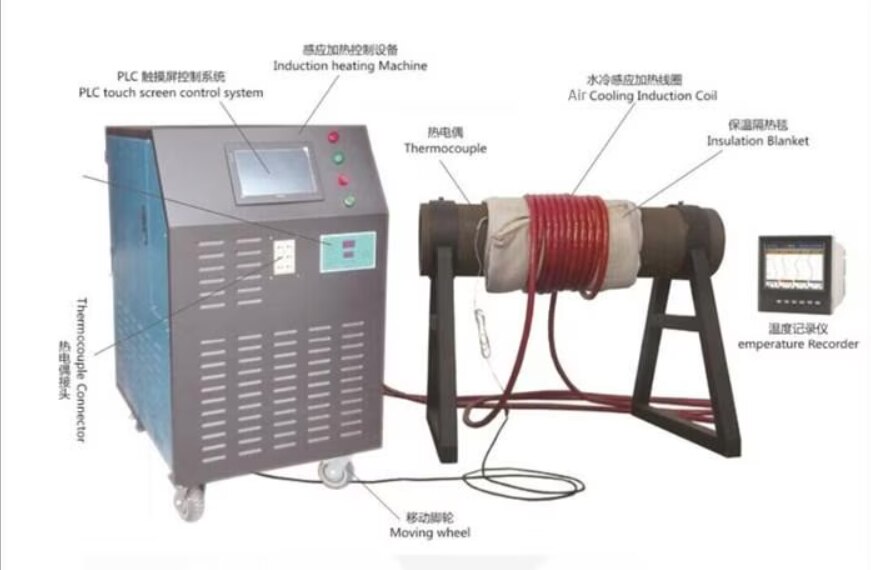
| Induction | Thick sections or rapid, high-input heating | Coil position and power changes can produce uneven temperature |
| Furnace | Small, removable components | The furnace must heat the entire component uniformly |
| Local gas heating | Large components where electrical capacity is limited | Flame concentration can overheat one area while leaving another cold |
For heat treatment for power plant piping, define the heated band from the approved procedure and code basis; extend it far enough beyond the weld and provide insulation across the band and adjacent cold areas to limit thermal gradients.
Place calibrated thermocouples at the weld, band edges and representative opposite surfaces, with extra channels on thick or complex sections.
Control the specified ramp-up and ramp-down rates, target soak temperature, allowable soak range and minimum duration through an independent recorder. A controller set point does not prove uniform weld temperature. Protect valves, supports, insulation, restraints and connected pipework from unintended heating.
The final chart must identify the weld, component, date, cycle, channels, actual ramp rates, soak range and duration, cooling rate, interruptions and corrective action. For P91, P92 and other Cr-Mo welds, use a material-specific qualified procedure and record the required hardness or other verification.
Buy and verify a treatment package, not just heater time
A quotation for post weld heat treatment in Nagpur is incomplete if it prices only heater hours. Compare the full package: engineering review, site survey, heaters, insulation, thermocouples, calibrated recorder, generator or power supply, fire watch, scaffolding, insulation reinstatement, chart documentation, hardness checks and retesting after a failed cycle.
1. Before mobilization, inspect the weld map, material grades, thicknesses, joint restraints, supports and access. Require the contractor’s written procedure, naming the heating method, target temperature, heating and cooling rates, soak range and duration, heated-band width, insulation, thermocouple layout, recorder, acceptance limits, and actions after power or recorder failure.
2. Make the work package control distortion as well as temperature. Record alignment and dimensions, confirm temporary supports, and identify branch connections or unequal-thickness joints that could move during treatment.
3. Set the examination sequence in writing: review WPS and weld records, complete specified visual and NDE examinations before PWHT, perform the approved cycle, then review the chart before removing equipment. After treatment, complete specified hardness checks and NDE, record repairs, and repeat the cycle and examinations when required.
4. Demand a chart identifying the weld or component, date, cycle, thermocouple channels, actual heating rate, soak range and duration, cooling rate, interruptions and disposition. A controller set point does not prove uniform weld temperature.
For postheat treatment for power plant welds in Nagpur, require material-specific controls for Cr-Mo and P91/P92 steel. Becquerel Industries Pvt Ltd can be evaluated against those records, not heater capacity alone; a credible postheat treatment service leaves an auditable package.
Related products
 | BIPL specializes in local Post weld heat treatment of carbon steel and alloy steel piping welds by means of the electrical resistance method, in the... View product → |
 | Stress Relieving Heat Treatment During the welding process, the two metal pieces being joined are subject to extreme temperatures and can cause the crystalline structure of the... View product → |
Frequently asked questions
When does power-plant piping require PWHT?
PWHT depends on the governing construction code, material, wall thickness, weld type and service conditions. Check ASME B31.1, the applicable boiler code and Indian Boiler Regulations where applicable.
How do preheat, interpass control, postheat and PWHT differ?
Preheat raises the parent metal before welding, interpass control limits temperature between weld passes, postheat holds the weld at a controlled temperature after welding, and PWHT uses a specified heating, soaking and cooling cycle after welding.
How should you choose a PWHT heating method?
Compare electrical resistance, induction and furnace treatment against weld geometry, site access, temperature range, thermal uniformity, insulation requirements and control capability.
What should a PWHT service package include?
Require a qualified procedure, calibrated equipment, thermocouple placement details, heating and cooling records, temperature charts, weld identification and a treatment report tied to the welding records.
Related products
 | Preheating involves rising the temperature of the parent material locally, on both sides of the joint to a value above ambient. View product → |
 | process is heating a steel above the critical temperature, holding for a period of time long enough for transformation to occur, and air cooling. View product → |
Keywords