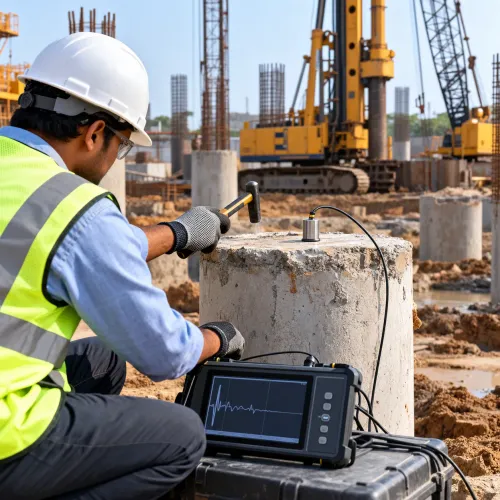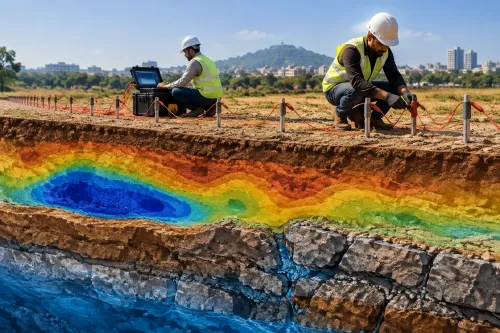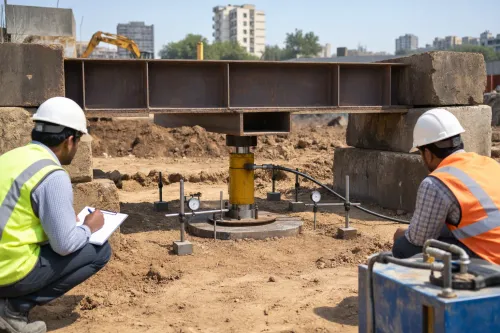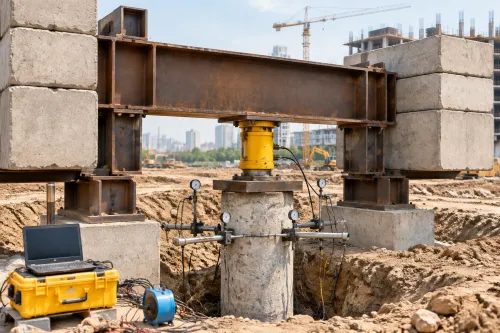
Large-diameter bored piles plus deep foundation elements can be difficult to assess after concreting. Surface inspection cannot show the internal condition of concrete deep below ground. Cross Hole Sonic Logging provides a specialized non-destructive testing method for assessing concrete quality between access tubes installed within the foundation element.
For bridges, major structures, industrial facilities, infrastructure projects around Nagpur, Maharashtra, this technique can support detailed quality assessment of selected deep foundations.
How Cross Hole Sonic Logging Works
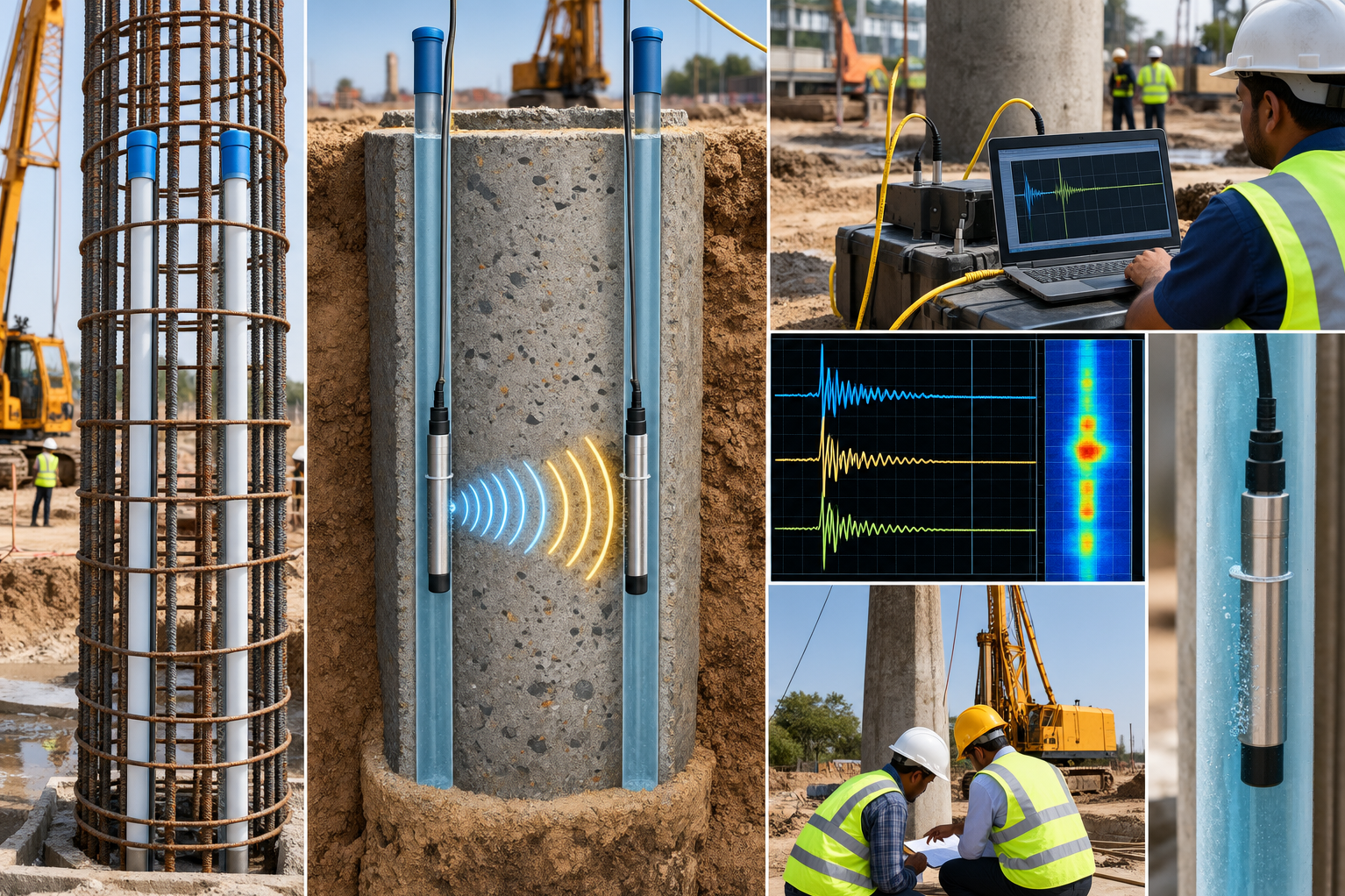
Access tubes are installed within the reinforcement cage before concreting.
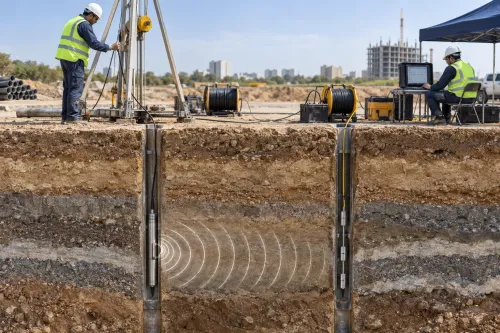
During testing, ultrasonic transmitter plus receiver probes are lowered through water-filled tubes.
The transmitter produces ultrasonic pulses. The receiver measures signal arrival characteristics after the pulse travels through concrete between the tubes.
Measurements are collected along the pile depth.
Changes in travel time plus signal energy can indicate variations in concrete quality.
Why Access Tubes Are Essential
Unlike certain surface-based integrity methods, sonic logging depends on access tubes embedded within the pile.
This means testing must be considered before concrete placement.
If access requirements are overlooked during foundation construction, conventional cross-hole sonic logging may not be feasible later.
Early coordination between foundation designers, piling contractors, testing specialists is therefore important.
What Can Sonic Logging Indicate?
The method may help identify zones showing anomalous ultrasonic response between tube pairs.
Such changes can be associated with variations in concrete condition.
Technical interpretation considers:
- Signal arrival time
- Relative energy
- Depth
- Tube pair
- Repeatability
- Overall response pattern
An anomalous signal should be assessed within the broader construction context before conclusions are reached.
Why Tube Layout Matters
Coverage depends partly on the number plus position of access tubes.
Larger foundation elements may require multiple tubes to provide suitable testing paths.
Tube installation should follow project specifications.
Tubes should remain securely fixed during reinforcement cage handling plus concreting. Damage, blockage, poor tube condition can affect test access.
Testing Preparation Checklist
Before scheduling fieldwork, project teams should verify that:
- Access tubes are identifiable
- Tubes remain unobstructed
- Required tube depth is accessible
- Suitable water filling has been completed
- Pile identification records are available
- Concrete age meets project requirements
- Testing area is accessible
- Relevant construction records are available
Good preparation helps field testing proceed efficiently.
When Additional Investigation May Be Required
Cross-hole sonic logging provides valuable information between access tubes, but technical interpretation may sometimes identify zones requiring further assessment.
Additional investigation could involve complementary non-destructive techniques, engineering review, core verification where specified.
The appropriate response depends on anomaly significance, structural requirements, foundation design, construction records.
Selecting a Testing Provider
Deep foundation testing requires specialized equipment plus experienced technical personnel.
Becquerel Industries Pvt Ltd supports non-destructive testing plus foundation investigation requirements for civil engineering, infrastructure, industrial projects in Nagpur plus wider Maharashtra locations.
Clients should evaluate technical capability, equipment condition, calibration practices, field procedures, reporting quality before appointing a provider.
For major foundations, testing is not simply about producing a graph. The objective is to obtain interpretable evidence concerning internal concrete condition at depths that cannot be visually examined.
Cross Hole Sonic Logging provides that evidence when access tubes are correctly installed, measurements are carefully collected, results are interpreted within the engineering context. Early planning therefore remains one of the most important requirements for successful sonic logging.
Keywords