Modern infrastructure projects increasingly require detailed information about the dynamic properties of subsurface materials. A Cross Hole Seismic Test is a specialized geophysical technique used to measure seismic wave velocities between boreholes.
The method can provide valuable data for geotechnical engineering, seismic design, major infrastructure development, industrial facilities, technically demanding civil projects.
For projects in Nagpur, Maharashtra, cross-hole testing may be specified where detailed subsurface seismic characterization is required.
How Cross-Hole Testing Works
The method typically uses prepared boreholes containing suitable access arrangements.
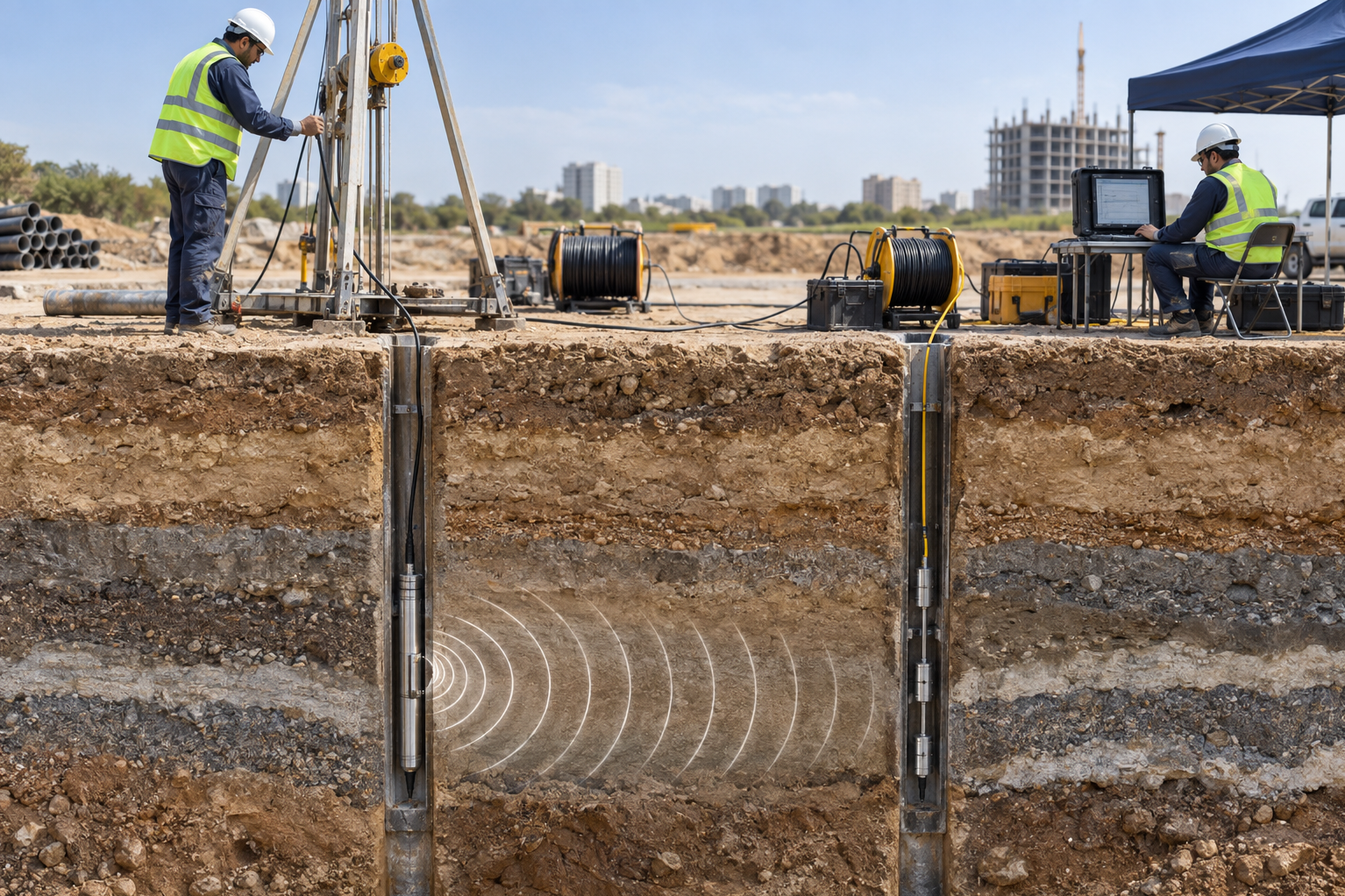
A seismic source is activated in one borehole. Receivers positioned in another borehole detect the arriving waves.
Measurements are collected at selected depths.
By knowing the distance between boreholes plus travel time, specialists can determine seismic wave velocity through the intervening ground.
Why Wave Velocity Matters
Different subsurface materials transmit seismic energy differently.
Wave velocity can provide information concerning stiffness plus dynamic characteristics.
Shear-wave velocity is particularly important in many geotechnical applications because it relates to small-strain shear stiffness.
Compressional-wave measurements may provide additional geological information.
Potential Engineering Applications
Cross-hole seismic testing can support:
- Dynamic soil characterization
- Seismic site studies
- Major foundation projects
- Infrastructure design
- Industrial facility assessment
- Earthquake engineering studies
- Ground response analysis
- Research-related geotechnical programs
The exact application depends on project specifications.
Borehole Preparation Influences Data Quality
Cross-hole testing requires careful borehole preparation.
Borehole geometry, casing condition, grout contact, depth control can influence measurements.
Accurate information concerning borehole spacing is also important because velocity calculations depend on travel distance.
Specialists may conduct deviation measurements where required to improve geometric accuracy.
Why This Technique Provides Detailed Information
Surface geophysical techniques measure responses from the ground surface.
Cross-hole testing places the source plus receivers within boreholes, allowing measurements to be taken directly across subsurface layers.
This can provide detailed depth-specific velocity information.
The approach is particularly useful when project requirements justify higher-resolution seismic characterization.
Site Coordination Before Testing
Cross-hole testing usually requires coordination between drilling teams, geotechnical consultants, geophysical specialists, project management.
Boreholes need suitable placement plus preparation before seismic measurements begin.
Project teams should confirm:
- Borehole spacing
- Target depth
- Casing requirements
- Grouting requirements
- Survey information
- Testing interval
- Required seismic parameters
- Reporting format
Early planning can prevent costly rework.
Selecting a Suitable Investigation Team
Specialized seismic testing requires suitable instruments plus experienced personnel.
Project stakeholders should review technical capability, calibration practices, data acquisition methods, processing methodology, reporting experience before appointing a provider.
Becquerel Industries Pvt Ltd supports geotechnical plus non-destructive investigation requirements for infrastructure, industrial, civil engineering projects.
For Nagpur projects requiring advanced subsurface characterization, cross-hole seismic testing can provide valuable depth-specific information when the investigation is properly designed.
The objective should be to produce technically defensible data that engineers can incorporate into analysis. Proper borehole preparation, accurate geometry, controlled measurements, professional interpretation are essential.
When these elements are handled carefully, cross-hole seismic testing becomes a powerful method for understanding dynamic ground properties beneath important infrastructure.
Keywords