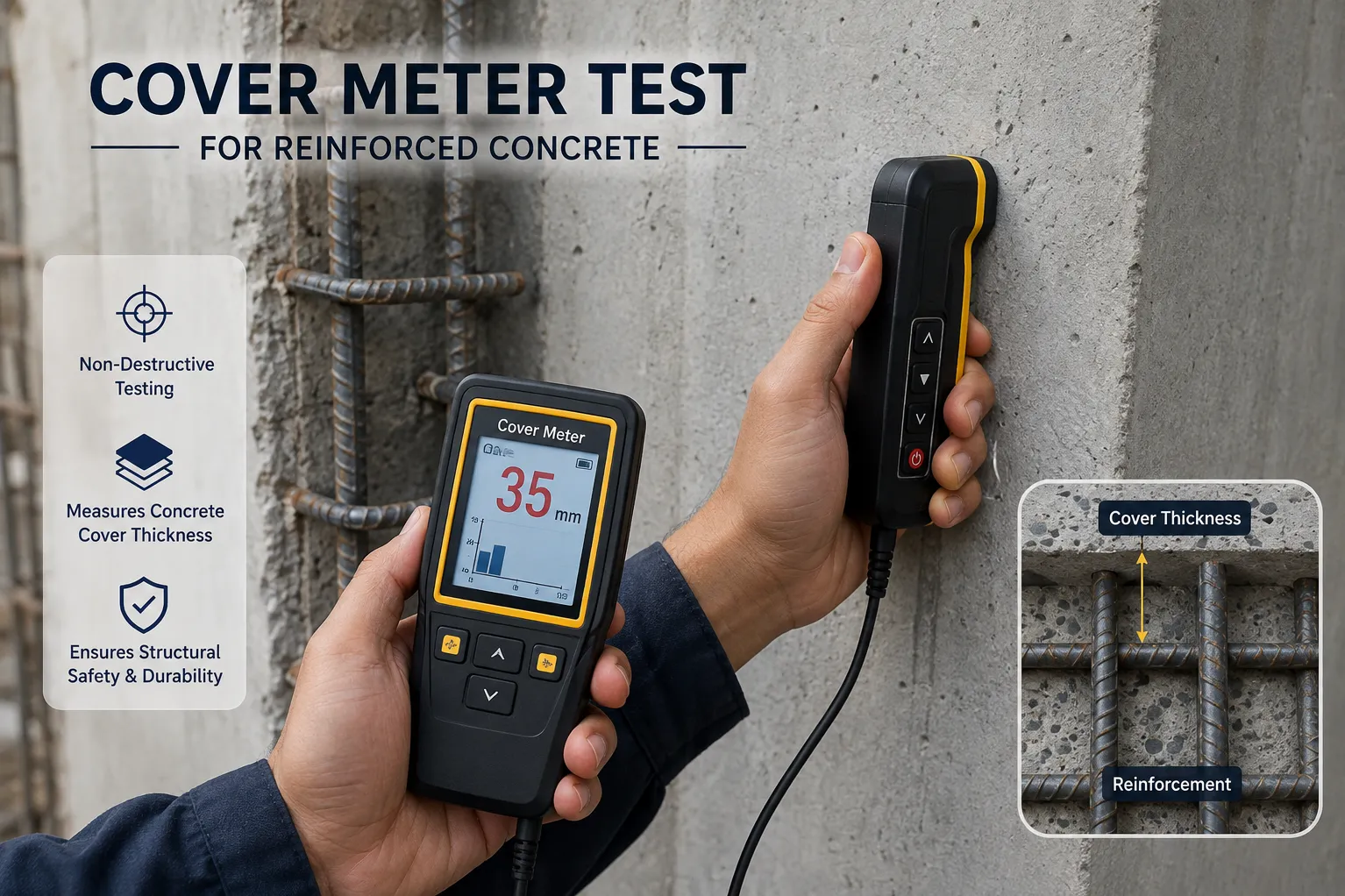
Concrete may conceal reinforcement from view, but engineers often need to know exactly where the steel bars are positioned before assessing, repairing or modifying a structure. A cover meter test provides this information without unnecessary breaking or drilling.
Becquerel Industries Pvt Ltd conducts cover meter testing for buildings, bridges and other reinforced concrete structures. The test helps project teams understand reinforcement layout, verify concrete cover and select safer locations for further investigation.
What Is a Cover Meter Test?
A cover meter test is a non-destructive testing method used to locate reinforcing steel embedded in concrete. Depending on the instrument, site conditions and testing objective, it may also help estimate:
- Depth of concrete cover over reinforcement
- Approximate position and spacing of reinforcing bars
- Orientation of reinforcement
- Approximate bar diameter under suitable conditions
- Areas where concrete cover may be insufficient
The instrument generally works by detecting the electromagnetic response produced by embedded steel. Readings are collected by moving the probe across the concrete surface.
Because the test does not require large openings in the concrete, it is useful for preliminary investigations and wider structural surveys.
Why Concrete Cover Is Important
Concrete cover is the distance between the exposed concrete surface and the nearest reinforcement. It protects steel from moisture, chlorides, carbon dioxide, heat and other environmental influences.
Adequate cover contributes to:
- Corrosion protection
- Fire resistance
- Proper bond between concrete and reinforcement
- Durability in aggressive exposure conditions
- Long-term structural performance
Insufficient cover may make reinforcement more vulnerable to corrosion. Excessive cover can also create concerns in certain elements because the effective position of the steel may differ from the intended design.
Cover Meter Testing for Structures in Nagpur
Buildings and infrastructure in Nagpur may be exposed to seasonal moisture, high summer temperatures, leakage or industrial environments. When cracks, rust stains or concrete spalling appear, locating the reinforcement becomes an important part of the investigation.
Cover meter surveys may be performed on:
- Columns and beams
- Floor and roof slabs
- Retaining walls
- Bridge decks and piers
- Water-retaining structures
- Industrial foundations
- Parking structures
- Older buildings with limited drawings
The method is also useful before core cutting, anchor installation or service penetrations. Identifying reinforcement helps reduce the risk of cutting through critical bars.
How the Test Is Carried Out
The surface is first inspected and cleaned so the probe can move consistently. A scanning grid may be marked where detailed mapping is required.
The operator then moves the probe across the selected area. Instrument indications help locate the centreline of the reinforcement. Cover readings are recorded at chosen points and may be plotted on drawings or marked directly on the surface.
Reliable testing requires attention to factors such as:
- Closely spaced reinforcement
- Multiple layers of steel
- Large bar diameters
- Metallic fixtures near the test zone
- Rough or uneven concrete surfaces
- Bar orientation
- Instrument calibration
Where reinforcement is congested, individual bars may be difficult to distinguish. Results should therefore be interpreted alongside structural drawings, visual observations and other test findings.
How the Results Support Structural Decisions
Cover meter findings can help engineers check whether reinforcement placement broadly corresponds with available drawings. The results can also guide carbonation testing, half-cell potential measurement, core extraction and repair work.
However, a cover meter test does not directly determine steel corrosion, concrete strength or the load capacity of a structural member. It answers specific questions about reinforcement location and cover.
A clearly documented survey should identify the tested areas, equipment used, grid spacing, observed bar locations and measured cover depths. When included within a broader structural assessment, the test provides practical data for maintenance planning, verification and safer intervention.
Keywords