Construction teams often need practical information about near-surface ground strength without relying exclusively on extensive excavation. A Dynamic Cone Penetration Test provides a field-based method for assessing penetration resistance through soil layers.
The technique can be useful for roads, pavement works, earthworks, industrial developments, infrastructure projects across Nagpur, Maharashtra, particularly where engineers need rapid information about relative ground conditions.
How the Test Works
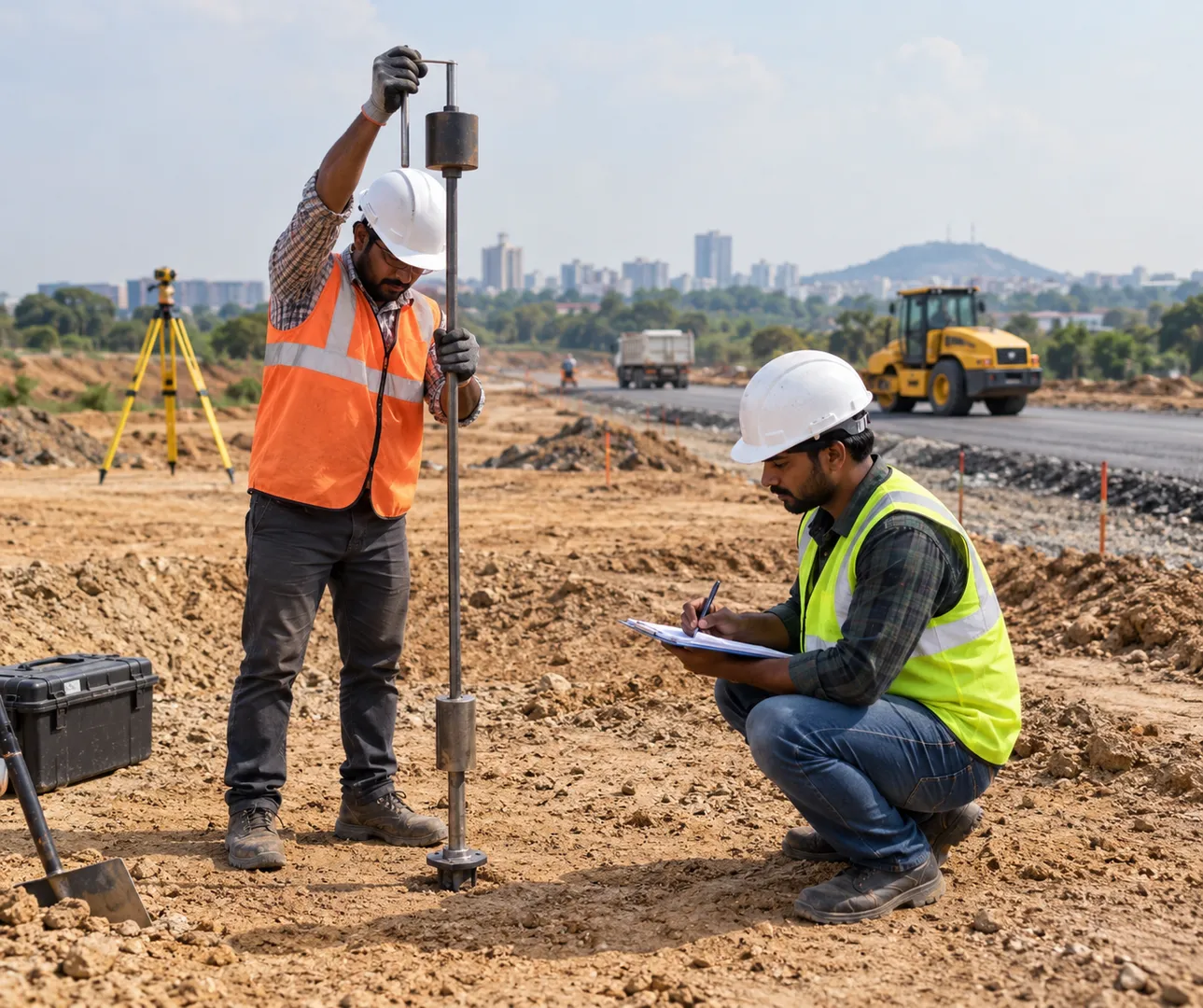
The test uses a cone driven into the ground through repeated impact from a standardized hammer arrangement.
Penetration produced by each impact is measured. Changes in penetration rate can indicate changes in material resistance with depth.
A layer showing rapid penetration generally behaves differently from a layer requiring many impacts for relatively small penetration.
The resulting profile can therefore help identify variations within the investigated ground.
What Can the Test Reveal?
Dynamic cone testing can provide useful information concerning:
- Relative soil resistance
- Layer consistency
- Weak zones
- Changes in compaction
- Subgrade variability
- Approximate strength trends
- Depth-related changes
Results require suitable engineering interpretation. The test does not replace every laboratory procedure, borehole investigation, specialized field test.
Instead, it provides an efficient method for obtaining field resistance information.
Road Construction Applications
One common application involves pavement projects.
Road performance depends significantly on subgrade condition. Localized weak areas can contribute to differential behaviour, premature distress, maintenance problems.
Dynamic penetration testing can help investigate existing ground before pavement construction. It may also support evaluation during rehabilitation projects where teams need information about underlying layers.
For highway, internal road, industrial road, logistics yard projects around Nagpur, rapid field assessment can support more focused ground improvement decisions.
Useful for Earthwork Assessment
Large developments frequently involve filling, grading, embankment construction.
Compaction quality can vary across extensive areas due to material differences, moisture variation, equipment coverage, lift thickness.
Penetration testing can help identify locations showing different resistance patterns. Engineers can then determine whether further investigation is required.
This approach can make field assessment more targeted.
Why Test Location Selection Matters
A few isolated test points cannot automatically represent an entire site.
Test locations should reflect project geometry, suspected weak areas, loading conditions, earthwork zones, visible variations.
For linear infrastructure, testing may be distributed along the proposed alignment. For industrial developments, tests may focus on roads, yards, building zones, filled areas.
A technically planned testing pattern provides more meaningful information than arbitrary sampling.
Results Need Context
Penetration resistance can be influenced by soil type, moisture, gravel content, density, other field conditions.
This means raw penetration readings should not be interpreted without knowledge of site conditions.
Where greater certainty is needed, dynamic cone data can be considered alongside borehole information, laboratory results, other field tests.
Combining multiple sources of evidence often produces a more complete ground assessment.
Why Rapid Field Testing Has Practical Value
Construction schedules frequently require timely decisions.
A relatively quick field method can help engineers identify areas requiring closer attention without delaying the entire project while extensive investigation is performed everywhere.
Becquerel Industries Pvt Ltd supports geotechnical field investigation for infrastructure, construction, industrial projects in Nagpur plus project locations across Maharashtra.
Dynamic cone penetration testing is particularly valuable when its purpose is clearly defined before testing begins. It can support subgrade assessment, earthwork evaluation, preliminary ground profiling, targeted investigation.
The strongest results come from treating the test as an engineering information tool rather than a simple site formality. Proper equipment, consistent testing procedure, accurate measurement, thoughtful interpretation help transform penetration readings into information that project teams can actually use.
Keywords