Compacted soil forms the working base for roads, foundations, embankments, industrial floors and other civil engineering structures. If the soil does not achieve the required density, it may settle, deform or lose strength after construction. Field Density Determination, commonly called FDD, helps verify whether the compacted layer meets the specified acceptance criteria.
The sand replacement method is widely used for field density testing where the excavated test hole can be measured accurately with calibrated sand. It is particularly relevant to roadwork, land development and infrastructure projects in Nagpur and other parts of Maharashtra.
What Is FDD by the Sand Replacement Method?
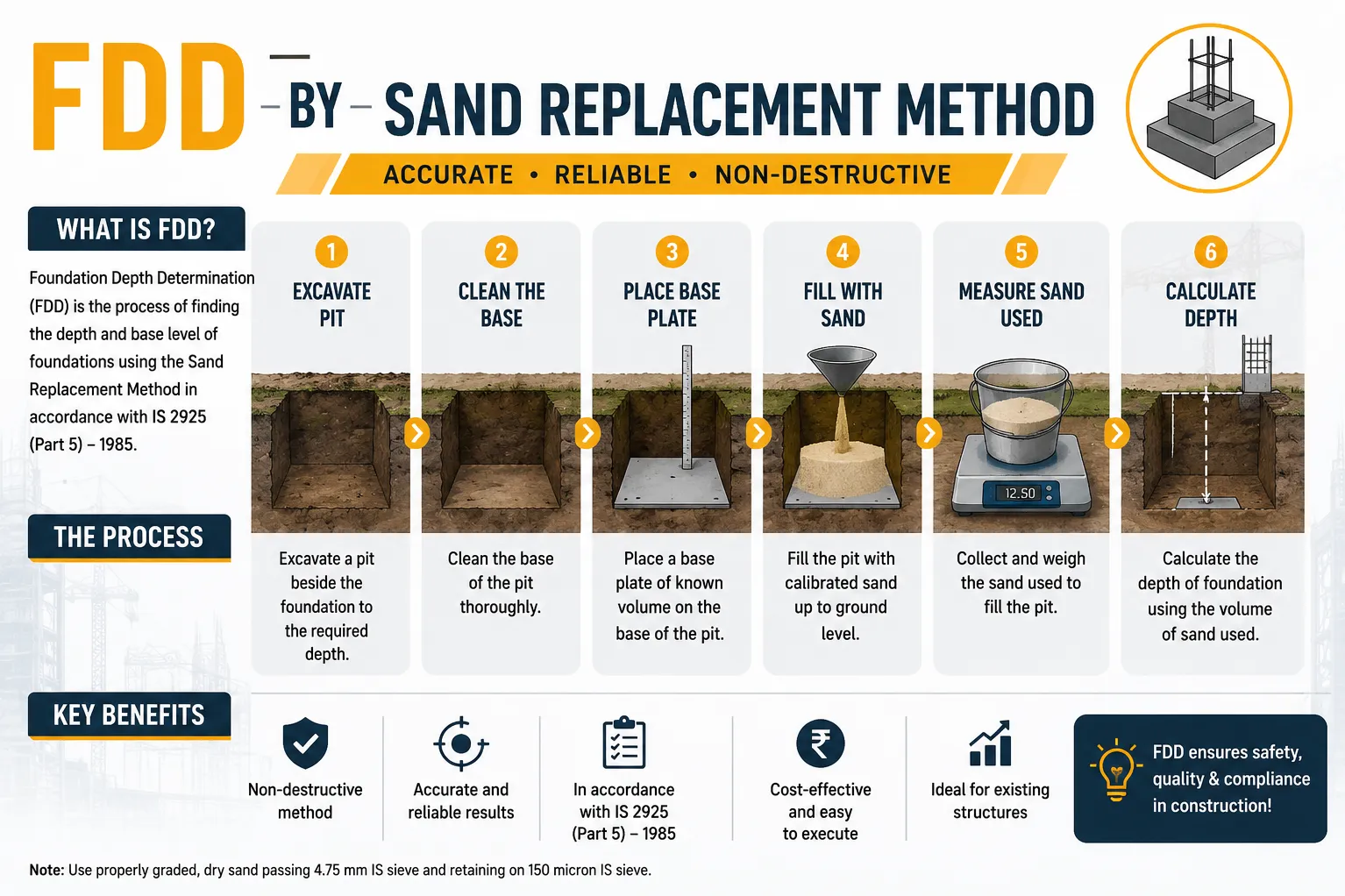
FDD by sand replacement is a field test used to determine the in-place bulk density and dry density of compacted soil. A small hole is excavated in the prepared layer, and the removed soil is collected and weighed.
The volume of the hole is then established by filling it with uniformly graded, free-flowing calibrated sand. Because the unit weight of the calibration sand is known, the hole volume can be calculated from the quantity of sand used.
The basic relationship is:
Field bulk density = Mass of excavated moist soil ÷ Volume of the test hole
The soil’s moisture content is determined separately. This value is used to calculate dry density, which is then compared with the laboratory maximum dry density obtained from the applicable compaction test.
Why Field Density Matters
Soil compaction reduces air voids and improves the engineering performance of the fill material. Adequate compaction generally contributes to:
- Better load-bearing capacity
- Reduced post-construction settlement
- Improved stability of embankments
- More uniform pavement performance
- Lower risk of rutting and surface deformation
- Improved support beneath slabs and foundations
Passing a roller over soil several times does not prove that the required density has been achieved. Moisture variation, lift thickness, soil type and equipment performance can all affect the result.
How the Sand Replacement Test Is Performed
The test location is first selected and prepared by removing loose surface particles. A metal tray with a central opening is placed on the surface, and a hole is excavated through the opening.
The usual process includes:
- Weighing and collecting all soil removed from the test hole
- Preventing moisture loss from the collected sample
- Determining the mass of sand required to fill the cone and tray correction
- Filling the excavated hole with calibrated sand
- Calculating the net mass of sand occupying the hole
- Determining the test-hole volume
- Measuring the soil’s moisture content
- Calculating field bulk density and dry density
- Comparing the result with the specified compaction requirement
Accurate calibration and careful handling are essential. Loss of excavated soil or disturbance around the hole can affect the final density value.
Common Sources of Testing Error
Reliable results depend on avoiding several practical mistakes:
- Using damp, contaminated or poorly graded calibration sand
- Failing to account for sand occupying the cone
- Excavating an irregular hole that collapses during testing
- Losing fine soil particles while collecting the sample
- Delaying moisture testing and allowing the sample to dry
- Testing too close to an edge or disturbed area
- Using calibration data that does not match the current sand batch
Site records should identify the test location, layer level, soil type and relevant laboratory compaction result.
Understanding the Test Result
The percentage compaction is generally calculated by comparing the field dry density with the laboratory maximum dry density. The required percentage depends on the project specification and the function of the compacted layer.
Becquerel Industries Pvt Ltd conducts FDD by the sand replacement method for civil and infrastructure projects in Nagpur. Proper field density testing gives contractors and project engineers objective evidence of compaction quality before the next layer or construction activity proceeds.
Keywords