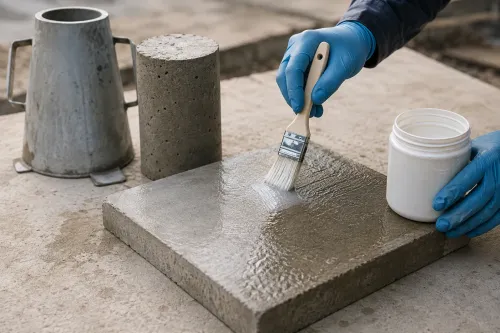
Reinforcement corrosion can develop inside concrete before major surface damage becomes visible. Rust formation may eventually cause cracking, delamination and spalling, but waiting for these signs can allow deterioration to progress. Half-cell potential testing is a non-destructive field method used to assess the probability of active corrosion in reinforcing steel.
For bridges, parking structures, industrial buildings and ageing concrete assets in Nagpur, this test can support condition assessment and repair planning without requiring extensive damage to the structure.
What Is a Half-Cell Potential Test?
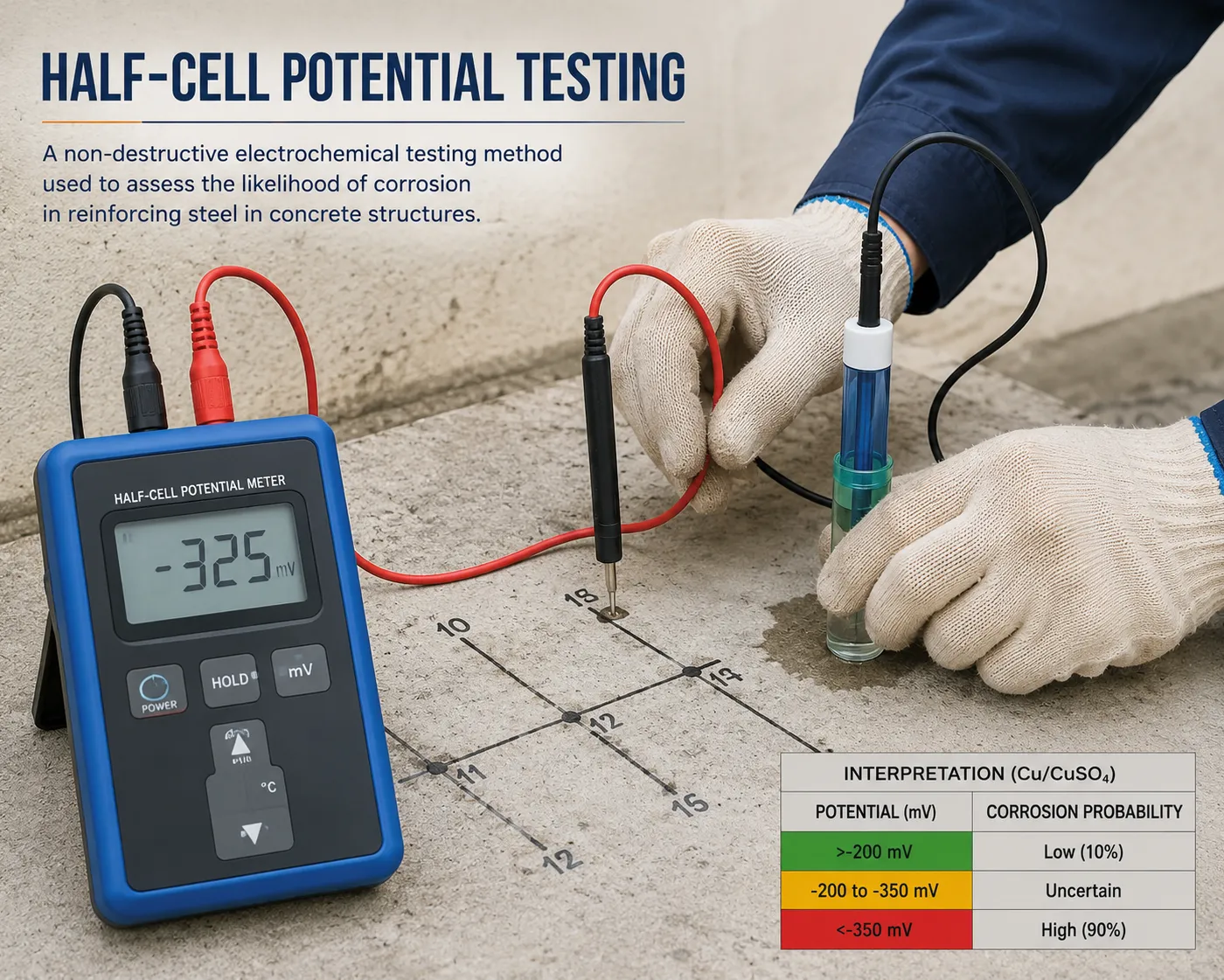
Half-cell potential testing measures the electrical potential difference between embedded reinforcing steel and a reference electrode placed on the concrete surface. Readings are collected across a defined grid to identify variations in electrochemical activity.
The method does not directly measure the amount of steel loss or the rate at which corrosion is occurring. Instead, it helps estimate the likelihood that corrosion activity is present at the tested locations.
This distinction is important. A potential reading should be treated as part of a broader structural investigation rather than as a complete diagnosis by itself.
Why Reinforcement Corrodes
Steel reinforcement is normally protected by the highly alkaline environment inside sound concrete. Corrosion may begin when that protective condition is disrupted.
Common causes include:
- Chloride penetration from contaminated water or materials
- Carbonation that lowers the concrete’s alkalinity
- Cracks that allow moisture and oxygen to reach the steel
- Inadequate concrete cover
- Porous or poorly compacted concrete
- Repeated wetting and drying
- Leakage through joints, decks or exposed surfaces
In Maharashtra’s varied exposure conditions, concrete structures may experience monsoon moisture, industrial pollutants, drainage problems and long-term weathering. These factors can contribute to deterioration when protective measures or maintenance are insufficient.
How Half-Cell Potential Testing Is Conducted
Before testing, engineers review the structure and identify accessible reinforcement. Electrical continuity between reinforcing bars is checked because the method depends on connection to the steel network.
A typical field procedure involves:
- Marking a measurement grid on the concrete surface
- Locating reinforcement where necessary
- Establishing an electrical connection to the steel
- Preparing or moistening the surface appropriately
- Placing the reference electrode at each grid point
- Recording stable potential readings
- Mapping the values to identify corrosion-prone zones
- Correlating the findings with cracks, spalls and exposure conditions
The grid spacing depends on the survey objective and the size of the structural element. Closely spaced readings can provide more detailed potential contours in critical areas.
Factors That Can Influence Readings
Half-cell potential results require qualified interpretation because several conditions may affect the measurements:
- Concrete moisture content
- Electrical resistivity
- Surface coatings or membranes
- Temperature
- Reinforcement continuity
- Concrete cover depth
- Chloride concentration
- Carbonation
- Cathodic protection systems
Dry concrete may make it difficult to obtain stable electrical contact. Coated surfaces may need suitable preparation or an alternative testing arrangement.
Why Corrosion Mapping Is More Useful Than One Reading
A single reading provides limited information. A grid-based survey shows how potentials change across the structure and helps identify areas with significant gradients or clusters of more negative values.
These maps can guide further examination through cover meter surveys, carbonation testing, chloride analysis, concrete resistivity measurements or carefully targeted breakout inspection. Combining methods produces a more dependable understanding of the reinforcement condition.
Becquerel Industries Pvt Ltd performs half-cell potential testing as part of field NDT and structural condition assessments in Nagpur. When correctly planned and interpreted, the test helps engineers locate probable corrosion activity, prioritize detailed investigation and develop more focused repair strategies for reinforced concrete structures.
Keywords