Once concrete has set and gained strength, its condition cannot be judged reliably from surface appearance alone. A smooth finish may conceal low strength, internal voids or poor compaction, while visible discoloration may not necessarily indicate structural weakness. Hardened concrete testing provides objective information for construction quality control and structural assessment.
Becquerel Industries Pvt Ltd assists contractors, developers and engineering consultants with laboratory and field evaluation of hardened concrete. Selecting the right test depends on whether the objective is routine strength verification, defect investigation or assessment of an existing structure.
What Is Hardened Concrete Testing?
Hardened concrete testing covers examinations performed after concrete has developed a solid state. Tests may assess compressive strength, density, permeability-related characteristics, internal uniformity or resistance to specified forms of deterioration.
Testing is commonly required for:
- New building and infrastructure projects
- Precast concrete products
- Concrete cores extracted from structures
- Investigation of low cube results
- Assessment before repair or strengthening
- Older structures with visible deterioration
- Verification after changes in materials or mix design
Field observations, construction records and laboratory results should be reviewed together to obtain a meaningful picture of concrete quality.
Compressive Strength Testing
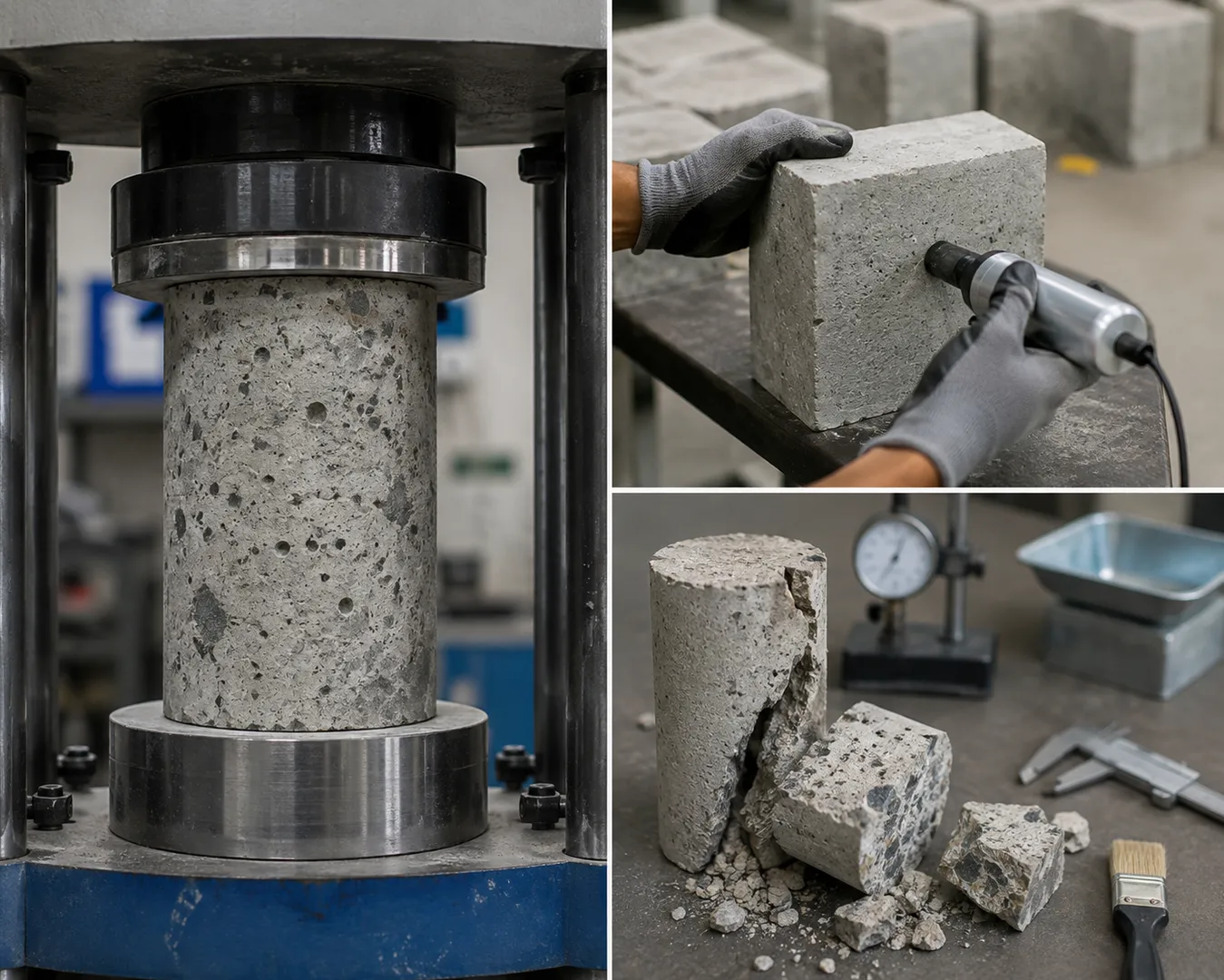
The compressive strength test is one of the most widely used evaluations of hardened concrete. Prepared cube or cylinder specimens are loaded in a compression testing machine until failure.
The result represents the maximum compressive stress sustained by the specimen. Its reliability depends on several factors:
- Correct sampling of fresh concrete
- Proper mould preparation
- Adequate compaction
- Controlled curing
- Accurate specimen dimensions
- Correct alignment in the testing machine
- Testing at the specified age
Poor specimen handling can produce results that do not accurately represent the concrete placed in the structure.
Core Testing of Existing Concrete
When the in-place strength of concrete needs evaluation, cylindrical cores may be extracted from selected structural locations. These samples are prepared and tested under controlled laboratory conditions.
Core testing requires careful planning because drilling creates a permanent opening. Locations should be selected to avoid critical reinforcement and minimise structural disturbance. A cover meter survey can help identify suitable drilling points.
Interpretation may need to consider:
- Core diameter and length
- Length-to-diameter ratio
- Reinforcement within the sample
- Moisture condition
- Direction of drilling
- Age and condition of concrete
- Damage caused during extraction
Core strength should not be compared casually with standard cube strength because specimen geometry and test conditions differ.
Hardened Concrete Testing for Nagpur Projects
Construction in Nagpur includes residential developments, industrial facilities, roads, bridges and public infrastructure. Concrete in these projects may be exposed to high temperatures, moisture cycles, leakage, chemicals or heavy service loads.
Depending on the investigation objective, testing may include:
- Compressive strength
- Density
- Water absorption
- Depth of water penetration
- Concrete core evaluation
- Ultrasonic pulse velocity
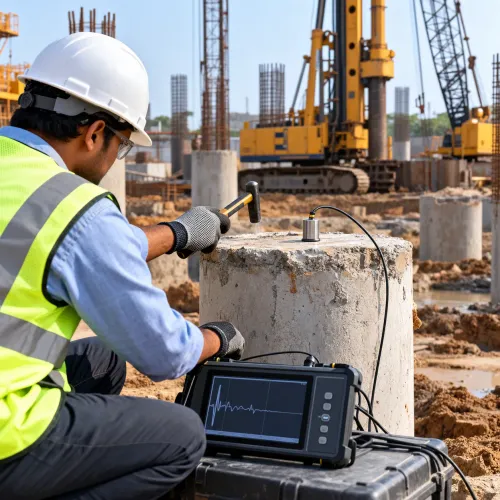
- Rebound hammer testing
- Carbonation depth
- Chemical analysis of concrete
Non-destructive methods are useful for surveys, but they do not always provide a direct substitute for laboratory strength testing. Combining methods can improve confidence in the assessment.
Avoiding Common Testing Mistakes
Testing only the visibly damaged area can provide an incomplete picture. The investigation should include comparison locations where appropriate.
Other common errors include poor sample identification, unrecorded curing conditions, arbitrary core selection and interpretation without considering construction history. A good report should clearly separate measured results from engineering conclusions.
If your project requires hardened concrete testing in Nagpur, connect with Becquerel Industries Pvt Ltd with details of the structure, concrete grade and concern being investigated. A defined testing plan will help select representative samples and produce results suited to practical engineering decisions.
Keywords